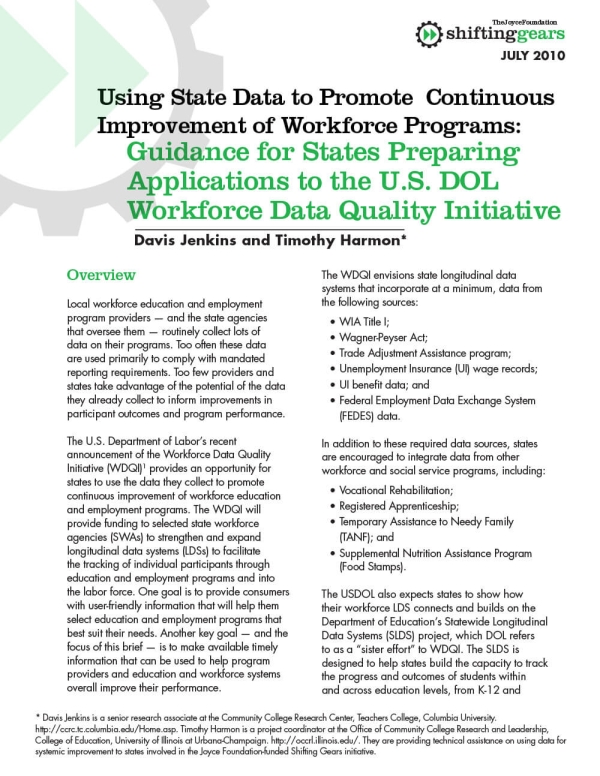
This brief describes how state workforce agencies can link education and workforce data to monitor how well their education and workforce development investments are meeting labor market needs.
Prepared for a Human Resources Development Group Meeting of the Asia-Pacific Economic Cooperation (APEC), this paper discusses a range of issues relevant to the community college mission of helping prepare a skilled workforce for jobs offering reasonable wages.
This paper makes the case for the training hour as the basic unit of measurement for noncredit workforce education programs and proposes a taxonomy of community college noncredit activities.
Drawing on a national review of state policies and case studies of 20 community colleges, this article examines trends in noncredit courses connected with workforce instruction and contract training.
This article elaborates on the increased importance of community colleges in training, retraining, and providing higher education in the recent economic downturn.
This paper presents findings from a study on the outcomes of students participating in Washington State's I-BEST program, which combines basic skills instruction with career-technical instruction.
Michelle Van NoyJames JacobsSuzanne KoreyThomas BaileyKatherine L. Hughes
This report provides detailed findings on state policies and community college practice from CCRC's study of community college noncredit workforce education.
This guide offers strategies for providing adults with education and training to help them access opportunities for social mobility and secure jobs that pay wages sufficient to support a family.
This paper presents a typology of the institutional partnerships in which community colleges engage so that policymakers can develop fiscal and regulatory policy to support such activities.